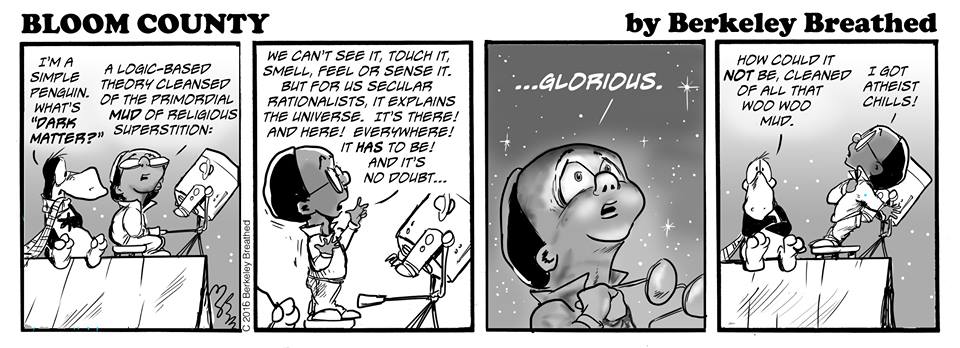
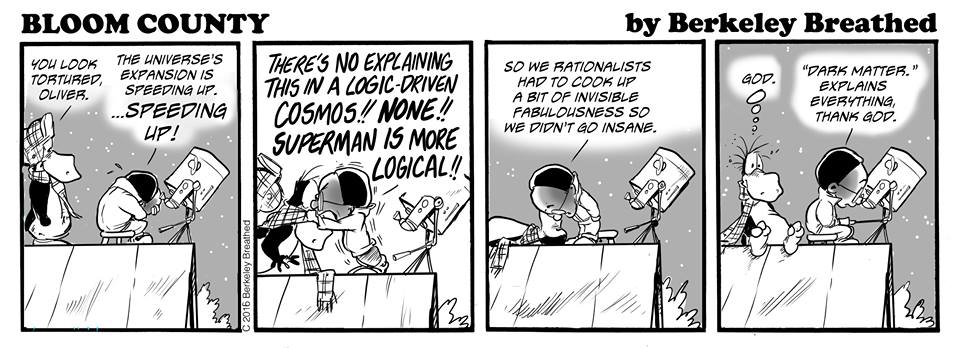
The history of science is a decision tree. Vertices appear where we must take one or another branching. Sometimes, we take the wrong road for the right reasons.
A good example is the geocentric vs. heliocentric cosmology. The ancient Greeks knew that in many ways it made more sense for the earth to revolve around the sun than vice-versa. Yet they were very clever. Ptolemy and others tested for the signature of the earth’s orbit in the seasonal wobbling in the positions of stars, or parallax. If the earth is moving around the sun, nearby stars should appear to move on the sky as the earth moves from one side of the sun to the other. Try blinking back and forth between your left and right eyes to see this effect, noting how nearby objects appear to move relative to distant ones.
Problem is, Ptolemy did not find the parallax. Quite reasonably, he inferred that the earth stayed put. We know now that this was the wrong branch to choose, but it persisted as the standard world view for many centuries. It turns out that even the nearest stars are so distant that their angular parallax is tiny (the angle of parallax is inversely proportional to distance). Precision sufficient for measuring the parallax was not achieved until the 19th century, by which time astronomers were already convinced it must happen.
Ptolemy was probably aware of this possibility, though it must have seemed quite unreasonable to conjecture at that time that the stars could be so very remote. The fact was that parallax was not observed. Either the earth did not move, or the stars were ridiculously distant. Which sounds more reasonable to you?
So, science took the wrong branch. Once this happened, sociology kicked in. Generation after generation of intelligent scholars confirmed the lack of parallax until the opposing branch seemed so unlikely that it became heretical to even discuss. It is very hard to reverse back up the decision tree and re-assess what seems to be such a firm conclusion. It took the Copernican revolution to return to that ancient decision branch and try the other one.
Cosmology today faces a similar need to take a few steps back on the decision tree. The problem now is the issue of the mass discrepancy, typically attributed to dark matter. When it first became apparent that things didn’t add up when one applied the usual Law of Gravity to the observed dynamics of galaxies, there was a choice. Either lots of matter is present which happens to be dark, or the Law of Gravity has to be amended. Which sounds more reasonable to you?
Having traveled down the road dictated by the Dark Matter decision branch, cosmologists find themselves trapped in a web of circular logic entirely analogous to the famous Ptolemaic epicycles. Not many of them realize it yet, much less admit that this is what is going on. But if you take a few steps back up the decision branch, you find a few attempts to alter the equations of gravity. Most of these failed almost immediately, encouraging cosmologists down the dark matter path just as Ptolemy wisely chose a geocentric cosmology. However, one of these theories is not only consistent with the data, it actually predicts many important new results. This theory is known as MOND (MOdified Newtonian Dynamics). It was introduced in 1983 by Moti Milgrom of the Weizmann Institute in Israel.
MOND accurately describes the effective force law in galaxies based only on the observed stars and gas. What this means is unclear, but it clearly means something! It is conceivable that dark and luminous matter somehow interact to mimic the behavior stipulated by MOND. This is not expected, and requires a lot of epicyclic thinking to arrange. The more straightforward interpretation is that MOND is correct, and we took the wrong branch of the decision tree back in the ’70s.
MOND has dire implications for much modern cosmological thought which has developed symbiotically with dark matter. As yet, no one has succeeded in writing down a theory which encompasses both MOND and General Relativity. This leaves open many questions in cosmology that were thought to be solved, such as the expansion history of the universe. There is nothing a scientist hates to do more than unlearn what was thought to be well established. It is this sociological phenomenon that makes it so difficult to climb back up the decision tree to the faulty branching.
Once one returns and takes the correct branch, the way forward is not necessarily obvious. The host of questions which had been assigned seemingly reasonable explanations along the faulty branch must be addressed anew. And there will always be those incapable of surrendering the old world view irrespective of the evidence.
In my opinion, the newsuccesses of MOND can not occur by accident. They are a strong sign that we are barking up the wrong tree with dark matter. A grander theory encompassing both MOND and General Relativity must exist, even if no one has as yet been clever enough to figure it out (few have tried).
These all combine to make life as a cosmologist interesting. Sometimes it is exciting. Often it is frustrating. Most of the time, “interesting” takes on the meaning implied by the old Chinese curse:
MAY YOU LIVE IN INTERESTING TIMES
Like it or not, we do.
*I wrote this in 2000. I leave it to the reader to decide how much progress has been made since then.
I want to take another step back in perspective from the last post to say a few words about what the radial acceleration relation (RAR) means and what it doesn’t mean. Here it is again:
The Radial Acceleration Relation over many decades. The grey region is forbidden – there cannot be less acceleration than caused by the observed baryons. The entire region above the diagonal line (yellow) is accessible to dark matter models as the sum of baryons and however much dark matter the model prescribes. MOND is the blue line.
This information was not available when the dark matter paradigm was developed. We observed excess motion, like flat rotation curves, and inferred the existence of extra mass. That was perfectly reasonable given the information available at the time. It is not now: we need to reassess as we learn more.
There is a clear organization to the data at both high and low acceleration. No objective observer with a well-developed physical intuition would look at this and think “dark matter.” The observed behavior does not follow from one force law plus some arbitrary amount of invisible mass. That could do literally anything in the yellow region above, and beyond the bounds of the plot, both upwards and to the left. Indeed, there is no obvious reason why the data don’t fall all over the place. One of the lingering, niggling concerns is the 5:1 ratio of dark matter:baryons – why is it in the same ballpark, when it could be pretty much anything? Why should the data organize in terms of acceleration? There is no reason for dark matter to do this.
Plausible dark matter models have been predicted to do a variety of things – things other than what we observe. The problem for dark matter is that real objects only occupy a tiny line through the vast region available to them in the plot above. This is a fine-tuning problem: why do the data reside only where they do when they could be all over the place? I recognized this as a problem for dark matter before I became aware$ of MOND. That it turns out that the data follow the line uniquely predicted* by MOND is just chef’s kiss: there is a fine-tuning problem for dark matter because MOND is the effective force law.
The argument against dark matter is that the data could reside anywhere in the yellow region above, but don’t. The argument against MOND is that a small portion of the data fall a little off the blue line. Arguing that such objects, be they clusters of galaxies or particular individual galaxies, falsify MOND while ignoring the fine-tuning problem faced by dark matter is a case of refusing to see the forest for a few outlying trees.%
So to return to the question posed in the title of this post, I don’t know why it had to be MOND. That’s just what we observe. Pretending dark matter does the same thing is a false presumption.
$I’d heard of MOND only vaguely, and, like most other scientists in the field, had paid it no mind until it reared its ugly head in my own data.
*I talk about MOND here because I believe in giving credit where credit is due. MOND predicted this; no other theory did so. Dark matter theories did not predict this. Mydark matter-based galaxy formation theory did not predict this. Other dark matter-based galaxy formation theories (including simulations) continue to fail to explain this. Other hypotheses of modified gravity also did not predict what is observed. Who+ ordered this?
Modified Dynamics. Very dangerous. You go first.
Many people in the field hate MOND, often with an irrational intensity that has the texture of religion. It’s not as if I woke up one morning and decided to like MOND – sometimes I wish I had never heard of it – but disliking a theory doesn’t make it wrong, and ignoring it doesn’t make it go away. MOND and only MOND predicted the observed RAR a priori. So far, MOND and only MOND provides a satisfactory explanation of thereof. We might not like it, but there it is in the data. We’re not going to progress until we get over our fear of MOND and cope with it. Imagining that it will somehow fall out of simulations with just the right baryonic feedback prescription is a form of magical thinking, not science.
MOND. Why’d it have to be MOND?
+Milgrom. Milgrom ordered this.
%I expect many cosmologists would argue the same in reverse for the cosmic microwave background (CMB) and other cosmological constraints. I have some sympathy for this. The fit to the power spectrum of the CMB seems too good to be an accident, and it points to the same parameters as other constraints. Well, mostly – the Hubble tension might be a clue that things could unravel, as if they haven’t already. The situation is not symmetric – where MOND predicted what we observe a priori with a minimum of assumptions, LCDM is an amalgam of one free parameter after another after another: dark matter and dark energy are, after all, auxiliary hypotheses we invented to save FLRW cosmology. When they don’t suffice, we invent more. Feedback is single word that represents a whole Pandora’s box of extra degrees of freedom, and we can invent crazier things as needed. The results is a Frankenstein’s monster of a cosmology that we all agree is the same entity, but when we examine it closely the pieces don’t fit, and one cosmologist’s LCDM is not really the same as that of the next. They just seem to agree because they use the same words to mean somewhat different things. Simply agreeing that there has to be non-baryonic dark matter has not helped us conjure up detections of the dark matter particles in the laboratory, or given us the clairvoyance to explain# what MOND predicted a prioi. So rather than agree that dark matter must exist because cosmology works so well, I think the appearance of working well is a chimera of many moving parts. Rather, cosmology, as we currently understand it, works if and only if non-baryonic dark matter exists in the right amount. That requires a laboratory detection to confirm.
#I have a disturbing lack of faith that a satisfactory explanation can be found.
In the previous post, we discussed how lensing data extend the Radial Acceleration Relation (RAR) seen in galaxy kinematics to very low accelerations. Let’s zoom out now, and look at things at higher accelerations and from a historical perspective.
This all started with Kepler’s Laws of Planetary Motion, which are explained by Newton’s Universal Gravitation – the inverse square law gbar = GM/r2 is exactly what is needed to explain the observed centripetal acceleration, gobs = V2/r. It also explains the surface gravity of the Earth. Indeed, it was the famous falling apple that is reputed to have given Newton the epiphany that it was the same force that made the apple fall to the ground that made the Moon circle the Earth that made the planets revolve around the sun.
The inverse square law holds over more than six decades of observed acceleration in the solar system, from the one gee we feel here on the surface of the Earth to the outskirts patrolled by Neptune.
Planetary motion in the radial acceleration plane. The dotted line is Newton’s inverse square law of universal gravity.*
The inverse square force law is what it takes to make the planetary data line up. A different force law would give a line with a different slope in this plot. No force law at all would give chaos, with planets all over the place in this plot, if, say, the solar system were run by a series of deferents and epicycles as envisioned for Ptolemaic cosmologies. In such a system, there is no reason to expect the organization seen above. It would require considerable contrivance to make it so.
Newtonian gravity and General Relativity are exquisitely well-tested in the solar system. There are also some very precise tests at higher accelerations that GR passes with flying colors. The story to lower accelerations is another matter. The most remote solar system probes we’ve launched are the Voyger and Pioneer missions. These probe down to ~10-6 m/s/s; below that is uncharted territory.
The RAR extended from high solar system accelerations to much low accelerations typical of galaxies – not the change in scale. Some early rotation curves (of NGC 55, NGC 801, NGC 2403, NGC 2841, & UGC 2885) are shown as lines. These probed an entirely new regime of acceleration. The departure of these lines from the dotted line are the flat rotation curves indicating the acceleration discrepancy/need for dark matter. This discrepancy was clear by the end of the 1970s, but the amplitude of the discrepancy then was modest.
Galaxies (and extragalactic data in general) probe an acceleration range that is unprecedented from the perspective of solar system tests. General Relativity has passed so many precise tests that the usual presumption is that is applies at all scales. But it is an assumption that it applies to scales where it hasn’t been tested. Galaxies and cosmology pose such a test. That we need to invoke dark matter to save the phenomenon would be interpreted as a failure if we had set out to test the theory rather than assume it applied.
It was clear from flat rotation curves that something extra was needed. However, when we invented the dark matter paradigm, it was not clear that the data were organized in terms of acceleration. As the data continued to improve, it became clear that the vast majority of galaxies adhered to a single, apparently universal+radial acceleration relation. What had been a hint of systematic behavior in early data became clean and clear. The data did not exhibit the scatter that as was expected from a sum of a baryonic disk and a non-baryonic dark matter halo – there is no reason that these two distinct components should sum to the single effective force law that is observed.
The RAR with modern data for both early (red triangles) and late (cyan circles) morphological types. The blue line is the prediction of MOND: there is a transition at an acceleration scale to a force law that is universal but no longer inverse-square.
The observed force-law happened to already have a name: MOND. If it had been something else, then we could have claimed to discover something new. But instead we were obliged to admit that the unexpected thing we had found had in fact been predicted by Milgrom.
This predictive power now extends to much lower accelerations. Again, only MOND got this prediction right in advance.
The RAR as above, extended by weak gravitational lensing observations. These follow the prediction of MOND as far as they are credible.
The data could have done many different things here. It could have continued along the dotted line, in which case we’d have need for no dark matter or modified gravity. It could have scattered all over the place – this is the natural expectation of dark matter theories, as there is no reason to expect the gravitational potential of the dominant dark matter halo to be dictated by the distribution of baryons. One expects that not to happen. Yet the data evince the exceptional degree of organization seen above.
It requires considerable contrivance to explain the RAR with dark matter. No viable explanation yet exists, despite many unconvincing claims to this effect. I have worked more on trying to explain this in terms of dark matter than I have on MOND, and all I can tell you is what doesn’t work. Every explanation I’ve seen so far is a special case of a model I had previously considered and rejected as obviously unworkable. At this point, I don’t see how dark matter can ever plausibly do what the data require.
I worry that dark matter has become an epicycle theory. We’re sure it is right, so whatever we observe, no matter how awkward or unexpected, must be what it does. But what if it is wrong, and it does not exist? How do we ever disabuse ourselves of the notion that there is invisible mass once we’ve convinced ourselves that there has to be?
Of course, MOND has its own problems. Clusters of galaxies are systems$ for which it persistently fails to explain the amplitude of the observed acceleration discrepancy. So let’s add those to the plot as well:
So: do clusters violate the RAR, or follow it? I’d say yes and yes – the offset, thought modest in amplitude in this depiction, is statistically significant. But there is also a similar scaling with acceleration, only the amplitude is off. The former makes no sense in MOND; the latter makes no sense in terms of dark matter which did not predict a RAR at all.
Clusters are the strongest evidence against MOND. Just being evidence against MOND doesn’t automatically make it evidence in favor of dark matter. I often pose myself the question: which theory requires me to disbelieve the least amount of data? When I first came to the problem, I was shocked to find that the answer was clearly MOND. Since then, it has gone back and forth, but rather than a clear answer emerging, what has happened is more a divergence of different lines of evidence: that which favors the standard cosmology is incommensurate with that which favors MOND. This leads to considerable cognitive dissonance.
One way to cope with cognitive dissonance is to engage with a problem from different perspectives. If I put on a MOND hat, I worry about the offset seen above for clusters. If I put on a dark matter hat, I worry about the same kind of offset for every system that is not a rich cluster of galaxies. Most critics of MOND seem unconcerned about this problem for dark matter, so how much should a critic of dark matter worry about it in MOND?
*For the hyper-pedantic: the eccentricity of each orbit causes the exact location of each planet in the first plot to oscillate up and down along the dotted line. The extent of this oscillation is smaller than the size of each symbol with the exception of Mercury, which has a relatively high eccentricity (but nowhere near enough to reach Venus).
+There are a few exceptions, of course – there are always exceptions in astronomy. The issue is whether these are physically meaningful, or the result of systematic uncertainties or non-equilibrium processes. The claimed discrepancies range from dubious to unconvincing to obviously wrong.
$I’ve heard some people criticize MOND because the centroid of the lensing signal does not peak around the gas in the Bullet cluster. This assumes that the gas represents the majority of the baryons. We know the is not the case, and that there is some missing mass in clusters. Whatever it is, it is clearly more centrally concentrated than the gas, so we don’t expect the lensing signal to peak where the gas is. All the Bullet cluster teaches us is that whatever this stuff is, it is collisionless. So this particular complaint is a logical fallacy of the a red herring and/or straw man variety born of not understanding MOND well enough to criticize it accurately. Why bother to do that when you come to the problem already sure that MOND is wrong? I understand this line of thought extraordinarily well, because that’s the attitude I started with, and I’ve seen it repeated by many colleagues. The difference is that I bothered to educate myself.
A personal note – I will be on vacation next week, so won’t be quick to respond to comments.
Last time, we discussed the remarkable result that gravitational lensing extends the original remarkable result of flat rotation curves much farther out, as far as the data credibly probe. This corroborates and extends the result of Brouwer et al. They did a thorough job, but one thing they did not consider was Tully-Fisher. If the circular speed inferred from gravitational lensing remains constant, does this flat velocity fall on the same Tully-Fisher relation that is seen in kinematic data?
We set out to answer this question. Along the way, we did three new things: 1. Dr. Mistele derived an improved method for doing the lensing analysis, extending the radial range over which the data were credible. 2. He explored the criteria by which galaxies were judged to be isolated, finding a morphological type dependence on how far out one had to exclude. 3. We reanalyzed the stellar masses of the KiDS sample to be consistent with those we used when analyzing the kinematic data of SPARC galaxies. The first two are connected, as how far out we can trust the data depends on how well we can define a clean sample of isolated galaxies. The third resolved an apparent offset between early type galaxies (ETGs, aka ellipticals) and late type galaxies (LTGs, aka spirals) seen by Brouwer et al. That appears to be an artifact of stellar population modeling, as I suspected when I first discussed their result. We don’t need to do any fitting of the mass-to-light ratio; the the apparent offset between types disappears when we use use the same population models for both kinematic and lensing data.
I could write a lot about each of these, but most of it is the stuff of technical details that would be dull to many people. If you’re into that sort of thing, go and read the long science paper which is where such details reside. Here I just want to describe the Tully-Fisher result. Spoiler alert: it is the same as that from kinematics.
First off, I’m talking strictly about the Baryonic Tully-Fisher relation: the scaling between baryonic mass and the flat rotation speed. To address this, we bin the lensing data by mass. The mass of each bin is well defined by the average of the many thousands of galaxies within the bin. By far the dominant uncertainty is the systematic in stellar mass caused by stellar population modeling. We went through this with a fine tooth comb, and I’m confident we have an internally self-consistent result. That doesn’t preclude it being wrong in an absolute sense – such is the nature of astronomy – but we can at least make a straight comparison between kinematic and lensing data using the same best-effort stellar mass estimates.
For the velocity, we estimate the average effective rotation curve for each mass bin from the lensing data. We also split the data into morphological types to look for differences. The statistics go down when one divvies up the data like this, so the uncertainties go up, but there are enough KiDS galaxies to define four mass bins. Here are their inferred rotation curves:
Figure 1 from Mistele et al. (2024). Circular velocities implied by weak lensing for four baryonic mass bins (most to least massive from the top row to the bottom) for the whole sample (left column), for LTGs (middle column), and for ETGs (right column). The lowest ETG mass bin is not shown because it contains too few lenses. Instead we show results for lenses with spectroscopic redshifts from GAMA, without splitting by mass or type due to the small sample size (gray and white symbols). For comparison, we also show results for KiDS without splitting by mass or type (small yellow symbols). Open symbols at small radii indicate where lenses are not yet effective point masses. Light-colored symbols (not-outlined) at large radii indicate data points that may still be reliable but where the isolation criterion is less certain. The error bars show the statistical errors. Horizontal lines and the corresponding shaded regions indicate the inferred Vflat values and uncertainties that we use for the BTFR. The extent of the horizontal lines indicates the radial range we consider when calculating Vflat.
Note that the average over all KiDS data shown in the lower right bin is the data shown in the press release image in the previous post, but the x-axis is logarithmic here. The GAMA data in that bin provide an important cross-check, as these galaxies have spectroscopic redshifts. They give the same answer as the larger KiDS sample, which relies on photometric redshifts. We need the larger sample to consider finer bins in mass, which is the rest of the plot.
Another thing to note here is that all the data in all the bins are consistent with remaining flat. There are some hints of a turn down at very large radii, particularly for LTGs in the second and third row, but these are not statistically significant, and only happen where the data start to become untrustworthy. Where exactly that happens is a judgement call.
Let’s take a closer look, with a comparison to radio data:
Figure 2 from Mistele et al. (2024).The circular velocities from weak lensing (circles) compared with those from gas kinematics (diamonds). The individual galaxies illustrated here have among the most extended 21 cm rotation curves in their mass bins; the lensing data continue to much larger radii still. The error bars show the statistical error, while the gray band indicates the systematic uncertainty in the radial accelerations. Symbol colors are as in Figure 1. Open symbols at large radii indicate where lenses are not sufficiently isolated. The solid green lines indicate the circular velocities of NFW halos and baryonic point masses appropriate for each mass bin. Green crosses indicate each NFW halo’s virial radius. The light green band adds a qualitative estimate of a two-halo term contribution to the NFW halo, which may become important at large radii in case our isolation criterion is imperfect there.
Again we see that the lensing data, averaged over many galaxies, extend much further out than the rotation curve of any one individual. The x-axis is again logarithmic, so the lensing data go way further out. They trace to 1 Mpc, which is crazy far beyond the observed ends of the most extended individual galaxies. A more conservative limit is the 300 kpc estimated by Brouwer et al. Surely we can go further than that, but how much further remains a judgement call.
What should we expect? The green lines show the rotation curve we’d expect for galaxy in an NFW halo with parameters specified by the stellar mass-halo mass relation of Kravtsov et al. (2018). Not all such relations agree well with kinematic data; this is the case that agrees most closely. We have intentionally cherry-picked the relation that makes LCDM look best. And it does look good up to a point, for example in the top two mass bins out to the virial radius of the halo (tick marks). Beyond that, not so much, and not at all for the two lower mass bins. The data extend far enough out that we should see the predicted decline. We do not.
The green line only represents the expected halo of the primary galaxy. When one gets so far out, one has to worry about all the other stuff out there. We’ve selected galaxies to be isolated, so there isn’t much that is luminous. But we can only exclude down to some sensitivity limit, there might be lots of tiny dwarf galaxies whose mass adds up and starts to affect the result. And of course there can be completely invisible dark matter. The green band attempts to account for this extra stuff in the so-called 2-halo term. This is hard to do, but we’ve made our best estimate based on the LCDM power spectrum. I’m sure the 2-halo term can be adjusted, but the shape is wrong. It will take some fine-tuning to get an effectively flat rotation curve out of the 1-halo+2 halo terms. They don’t naturally do that.
Something that is easy to do is define a flat value of the rotation speed. That’s just the average over the lensing data. We exclude the points at R < 50 kpc, as the assumption of a spherical mass that we make in the lensing analysis isn’t really valid at those comparatively small scales. We tried averaging over a bunch of different ranges, all of which gave pretty much the same answer. For illustration, we show two cases: a conservative one that only uses the data at R < 300 kpc, and another that goes out to 1 Mpc. Having measured Vflat over these ranges, we can plot Tully-Fisher:
Figure 3 from Mistele et al. (2024). The baryonic Tully–Fisher relation implied by weak lensing for the entire sample (yellow symbols, left column) and for ETGs and LTGs separately (red and blue symbols, right column). The Vflat values are weighted averages of the Vc values shown in Figure 1 for 50 kpc < R < 300 kpc (first row) and 50 kpc < R < 1000 kpc (second row). Vertical error bars represent a 0.1 dex systematic uncertainty on M*/L. For comparison, we also show the best fit to the kinematic data from Lelli et al. (2019; solid gray line) and the corresponding binned kinematic data (white diamonds).
Lo and behold, we find the same Baryonic Tully-Fisher relation from lensing data as we find with kinematics. This does not surprise me, but it didn’t have to be true. It shouldn’t be true in LCDM: if we can measure out to the virial radius, we should see some indication of a decline in velocity. We have and we don’t.
We also see no statistically significant separation between ETGs and LTGs. This is important, as a theory like MOND predicts that there should be no morphology dependence: only the baryonic mass matters. Brouwer et al. did see an indication of such a split, but it was small compared to the uncertainty in stellar population models. We don’t see it when we use our own stellar mass estimates. This is particularly true in the more conservative (300 kpc) case. There is a hint of a segregation when we average out to 1000 kpc, but the statistics say this isn’t significant. Since the lowest mass bin is most affected, I suspect this is a hint that the isolation criterion is failing first for the smallest galaxies. That makes sense, as the sensitivity limit on interlopers makes the lowest mass bin most susceptible to having its signal inappropriately boosted. It also makes sense that ETGs would be affected first, as ETGs are known to be more clustered than LTGs. It is really hard to define an isolated sample of ETGs, as discussed at length by Mistele et al.
That hasn’t prevented people from overlooking these basic facts in order to get to the apparent if statistically meaningless difference between ETGs and LTGs. Nevermind the successes! The slight offset between ETGs and LTGs falsify MOND! Seriously: other scientists have already made this argument to me while completely eliding the successes of MOND. It’s a case of refusing to see the forest for a tree that’s a little away from the others.
I think I said something about how this would happen when I first wrote about Brouwer et al‘s lensing result. Ah yes, here it is:
MOND predicted this behavior well in advance of the observation, so one would have to bend over backwards, rub one’s belly, and simultaneously punch oneself in the face to portray this as anything short of a fantastic success of MOND.
I say that because I’m sure people will line up to punch themselves in the face in exactly this fashion.
And so it has come to pass. Sometimes human behavior is as predictable as galaxy dynamics.
*There are many claims to explain limited portions of these results, but none are satisfactory. There is no LCDM model that matches the entire dynamic range of the radial acceleration relation. See, for example, Fig. 5 of Brouwer et al. (reproduced below), which shows the MICE and BAHAMAS simulations. Neither extend into the regime that is well-constrained by kinematic data; there is no reason to think they would successfully do so and good reason to think otherwise. MICE comes nowhere close to this regime and has no baryonic physics that would allow it do even address this question. BAHAMAS comes close but appears to turn away from the kinematic data before it gets there. We’ve built our own LCDM models; they don’t work either. We can make them come close, but only over a limited dynamic range, not over the full span of the data. It isn’t good enough to only explain a limited range of the data. One has to explain the full range, and the only theory that does that so far is MOND.
Fig. 5 from Brouwer et al. showing the radial acceleration relation inferred from the MICE (red band) and BAHAMAS (orange band) simulations. Not also that in our assessment of stellar masses, the lower acceleration points translate a bit to the right.
That rotation curves become flat at large radii is one of the most famous results in extragalactic astronomy. This had been established by Vera Rubin and her collaborators by the late 1970s. There were a few earlier anecdotal cases to this effect, but these seemed like mild curiosities until Rubin showed that the same thing was true over and over again for a hundred spiral galaxies. Flat rotation curves took on the air of a de facto natural law and precipitated the modern dark matter paradigm.
Optical and radio data
Rotation curves shouldn’t be flat. If what we saw was what we got, the rotation curve would reach a peak within the light distribution and decline further out. Perhaps an illustration is in order:
The rotation curve (data points, left) of NGC 6946 (right). The red line shows the expected rotation curve for the detected normal matter, which includes both the stars (yellow, from 2MASS) and atomic gas (blue, from THINGS). This provides a good description of the inner rotation curve but falls short further out. The excess observed rotation leads to the need for dark matter or MOND. Also noted is the extent of the rotation curve measured optically to the effective edge of the stars (Daigle et al. 2006; Epinat et al. 2008) and that measured with radio interferometric observations of the gas (Boomsma et al. 2008).
An obvious question is how far out rotation curves remain flat. In the rotation curves traced with optical observations by Rubin et al., the discrepancy was clear but modest – typically a factor of two in mass. It was possible to imagine that the mass-to-light ratios of stars increased with radius in a systematic way, bending the red line above to match the data out to the edge of the stars. This seemed unlikely, but neither did it seem like a huge ask.
Once one gets to the edge of the stellar distribution, most of the mass has been encompassed, and the rotation curve really should start to decline. Increasing the mass-to-light ratio of the stars ceases to be an option once we run out of stars*. Fortunately, the atomic gas typically extends to larger radii, so provides a tracer further out. Albert Bosma pursued this until there were again enough examples to establish that yes, flat rotation curves were the rule. They extended much further out, well beyond where the mass of the observed stars and gas could explain the data.
How much further out? It depends on the galaxy. A convenient metric is the scale length of the disk, which is a measure of the extent of the light distribution. Some galaxies are bigger than others. The peak of the contribution of the stars to the rotation curve occurs around 2.2 scale lengths. The rotation curve of NGC 6946 extends to about 7 scale lengths, far enough to make the discrepancy clear. For a long time, the record holder was NGC 2403, with a rotation curve that remains flat for 20 scale lengths.
Twenty scale lengths is a long way out. It is observations like this that demanded dark matter halos that are much larger than the galaxies they contain. They also posed a puzzle, since we were still nowhere near finding the edge of the mass distribution. Rotation curves seemed to persist in being flat indefinitely.
Postdoc Tobias Mistele worked out an elegant technique to improve the analysis of lensing data. His analysis corroborates the findings of Brouwer et al. It also provides the opportunity to push further out.
Weak gravitational lensing is a subtle effect – so subtle that one must coadd thousands of galaxies to get a signal. Beyond that, the limiting effect on the result is how isolated the galaxies are. Lensing is sensitive to all mass; if you go far enough out you start to run into other galaxies whose mass contributes to the signal. So one key is to identify isolated galaxies, and restrict the sample to them. KiDS is large enough to do this. Indeed, Mistele was able to show that while neighbors+ were a definite concern for elliptical galaxies, they were much less of a problem for spirals. Consequently, we can trace the implied rotation curve way far out.
How far out? In a new paper, Mistele shows that rotation curves continue way far out. Way way way far out. I mean, damn.
The average rotation curve of isolated galaxies (blue points) inferred from KiDS gravitational lensing data. This remains flat well beyond a million light-years with no end in sight. The width of the figure is the distance between the Milky Way and Andromeda. For comparison, the rotation curve of a single galaxy, UGC 6614, is shown in red. An image of the galaxy is shown to scale centered at the origin. UGC 6614 was selected for this illustration because it has a comparable rotation speed to the KiDS average and because it is one of the largest galaxies known: the red points are already a very extended rotation curve. Image credit: Mistele, Lelli, & McGaugh 2024.
Optical rotation curves typically extend to the edge of the stellar disk. That’s about 8 kpc in the example of NGC 6946 given above. Radio observations of the atomic gas of that galaxy extend to 17 kpc. That fits within the first two tick marks on the graph with the lensing rotation curve.
UGC 6614 is a massive galaxy with a very extended low surface brightness disk. Its rotation curve is traced by radio data to over 60 kpc. It is one of the most extended individual rotation curves known. The statistical lensing data push this out by a factor of ten, and more, with no end in sight. The flat rotation curves found by Rubin and Bosma and everyone else appear to persist indefinitely.
So what does it mean? First, flat rotation curves really are a law of nature, in the same sense of Kepler’s laws of planetary motion. Galaxies don’t obey those planetary rules, they have their own set of rules. This is what nature does.
In terms of dark matter halos, the extent of isolated galaxy rotation curves is surprisingly large. Just as we come to the edge of the stellar disk, then the gas disk, we should eventually hit the edge of the dark matter halo. In principle we can imagine this to be arbitrarily large, but in practice there are other galaxies in the universe so this cannot go one forever.
In the context of LCDM, we now have a pretty good idea of how extended halos should be from abundance matching. A galaxy of the mass of UGC 6614 should live in a halo with a virial radius of about 300 kpc or less. There is some uncertainty in this, of course, but we really should have hit the edge with the lensing data. There should be some sign of it, but we see none.
One complication is the so-called 2-halo term. In addition to the primary dark matter halo that hosts a galaxy, when you get very far out, you run into other halos. Isolated galaxies are selected to avoid this to the extent possible, but eventually there will be some extra mass that causes extra lensing signal that would cause an overestimate of the rotation speed. I’ll forgo a detailed discussion of this for now (see Mistele et al. if you’re eager), but the bottom line is that it would require some unnatural fine-tuning for the 1+2 halo terms to add up to such flat rotation curves. There ought to be a perceptible feature in the transition from the primary halo to the surrounding environment. We don’t see that.
In the context of MOND, a flat rotation curve that persists indefinitely is completely natural. That’s what an isolated galaxy should do. Even in MOND there should be an environmental effect: the mass of everything else in the universe should impose an external field effect that eventually limits the extent of the rotation curve. How this transition happens depends on the density of other galaxies; by selecting isolated galaxies this effect is put off as much as possible. Hopefully it will be detected as the data improve from projects like Euclid.
The primary prediction of MOND is an indefinitely extended rotation curve; the external field effect is a subtle detail. Yet again, that is what we see: MOND gets it right without really trying, and in a way that makes little sense in terms of dark matter. Sometimes I wish MOND had never been invented so we could claim to have discovered something profoundly new, or at least discuss the empirical result without concern that the data would get confused with the theory. MOND predictions keep being corroborated, yet the community persists in ignoring its implications, even in terms of dark matter. It’s gotta be telling us something.
We have a press release about this result, so perhaps you will see it kicking around your news feed.
*We could, of course, invoke dark stars, but that’s just an invisible horse of a different color.
+There is a well known correlation between morphology and density such that elliptical galaxies tend to live in the densest environments. This means that they are more likely to have neighbors that interfere with the lensing measurement, so finding that identifying isolated ellipticals with a clean lensing signal is more challenging that finding isolated spirals comes as no surprise. Isolated ellipticals do exist so it is possible, but one has to be very restrictive with the sample.
I just got back from a visit to the Carnegie Institution of Washington where I gave a talk and saw some old friends. I was a postdoc at the Department of Terrestrial Magnetism (DTM) in the ’90s. DTM is so-named because in their early days they literally traveled the world mapping the magnetic field. When I was there, DTM+ had a small extragalactic astronomy group including Vera Rubin*, Francois Schweizer, and John Graham. Working there as a Carnegie Fellow gave me great latitude to pursue whatever science I wanted, with the benefit of discussions with these great astronomers. After my initial work on low surface brightness galaxies had brought MOND to my attention, much of the follow-up work checking all (and I do mean all) the other constraints was done there, ultimately resulting in the triptych of papers showing that the bulk of the evidence available at that time favored MOND over the dark matter interpretation.
When I joined the faculty at the University of Maryland in 1998, I saw the need to develop a graduate course on cosmology, which did not exist there at that time. I began to consider how cosmic structure might form in MOND, but was taken aback when Simon White asked me to referee a paper on the subject by Bob Sanders. He had found much what I was finding, that there was no way to avoid an early burst of speedy galaxy formation. I had been scooped!
It has taken a quarter century to test our predictions, so any concern about who said what first seems silly now. Indeed, the bigger problem is informing people that these predictions were made at all. I had a huge eye roll last month when Physics Magazine came out with
February 12, 2024 NEWS FEATURE JWST Sees More Galaxies than Expected February 9, 2024
The new JWST observatory is revealing far more bright galaxies in the early Universe than anyone predicted, and astrophysicists have more than one explanation for the puzzle.
Far more bright galaxies in the early Universe than anyone predicted! Who could have predicted it? I guess I am anyone.
Joking aside, this is a great illustration of the inefficiency of scientific communication. I wrote a series of papers on the subject. I wasn’t alone; so did others. I gave talks about it. I’ve emphasized it in scientific reviews. My papers are frequently cited, ranking in the top 2% among the top 2% across all sciences. They’re cited by prominent cosmologists. Heck, I’ve even blogged about it. And yet, it comes as such a surprise that it couldn’t have possibly happened, to the extent that no one bothers to check what is in the literature. (There was a similar sociology around the prediction of the CMB second peak. It didn’t happen if we don’t look.)
So what did the Physics Magazine article talk about? More than one explanation, most of which are the conventionalist approaches we’ve talked about before – make star formation more efficient, or adjust the IMF (the mass spectrum with which stars form) to squeeze more UV photons out of fewer baryons. But there is also a paper by Sabti et al. that basically asserts “this can’t be happening!” which is exactly the point.
Sabti et al. ask whether the can boost the amplitude of structure formation in a way that satisfies both the new JWST observations and previous Hubble data. The answer is no:
We consider beyond-ΛCDM power-spectrum enhancements and show that any departure large enough to reproduce the abundance of ultramassive JWST candidates is in conflict with the HST data.
At first, this struck me as some form of reality denial, like an assertion that the luminosity density could not possible exceed LCDM predictions, even though that is exactly what it is observed to do:
The integrated UV luminosity density as a function of redshift from Adams et al. (2023). The data exceed the expectation for z > 10, even with the goal posts in motion.
On a closer read, I realized my initial impression was wrong; they are making a much better argument. The star formation rate is what is really constrained by the UV luminosity, but if that is attributed to stellar mass, you can’t get there from here – even with some jiggering of structure formation. That appears to be correct, within the framework of their considerations. Yet an alteration of structure formation is exactly what led to the now-corroborated prediction of Sanders (1998), so something still seemed odd. Just how were they altering it?
It took a close read, but the issue is in their equation 3. They allow for more structure formation by increasing the amplitude. However, they maintain the usual linear growth rate. In effect, they boost the amplitude of the linear dashed line in the left panel below, while maintaining its shape:
The growth rate of structure in CDM (linear, at left) and MOND (nonlinear, at right).
This is strongly constrain at both higher and lower redshifts, so only a little boost in amplitude is possible, assuming linear growth. So what they’ve correctly shown is that the usual linear growth rate of LCDM cannot do what needs to be done. That just emphasizes my point: to get the rapid growth we observe in the narrow time range available above redshift ten, the rate of growth needs to be nonlinear.
Nonlinearity is unavoidable in MOND – hence the prediction of big galaxies at high redshift. Nonlinearity is a bear to calculate, which is part of the reason nobody wants to go there. Tough nougies. They teach us in grad school that the early universe is simple. It is a mantra to many who work in the field. I’m sorry, did God promise this? I understand the reasons why the early universe should be simple in standard FLRW cosmology, but what if the universe we live in isn’t that? No one has standing to promise that the early universe is as simple as expected. That’s just a fairy tale cosmologists tell their young so they can sleep at night.
+DTM has since been merged with the Geophysical Laboratory to become the Earth and Planets Laboratory. These departments shared the Broad Branch Road campus but maintained a friendly rivalry in the soccer Mud Cup, so named because the first Mud Cup was played on a field that was a such a quagmire that we all became completely covered in mud. It was great fun.
*Vera was always adamant that she was not a physicist, and yet a search returns the thumbnail
even though the Wikipedia article itself does not (at present) make this spurious “and physicist” assertion.
The results from the high redshift universe keep pouring in from JWST. It is a full time job, and then some, just to keep track. One intriguing aspect is the luminosity density of the universe at z > 10. I had not thought this to be problematic for LCDM, as it only depends on the overall number density of stars, not whether they’re in big or small galaxies. I checked this a couple of years ago, and it was fine. At that point we were limited to z < 10, so what about higher redshift?
It helps to have in mind the contrasting predictions of distinct hypotheses, so a quick reminder. LCDM predicts a gradual build up of the dark matter halo mass function that should presumably be tracked by the galaxies within these halos. MOND predicts that galaxies of a wide range of masses form abruptly, including the biggest ones. The big distinction I’ve focused on is the formation epoch of the most massive galaxies. These take a long time to build up in LCDM, which typically takes half a Hubble time (~7 billion years; z < 1) for a giant elliptical to build up half its final stellar mass. Baryonic mass assembly is considerably more rapid in MOND, so this benchmark can be attained much earlier, even within the first billion years after the Big Bang (z > 5).
In both theories, astrophysics plays a role. How does gas condense into galaxies, and then form into stars? Gravity just tells us when we can assemble the mass, not how it becomes luminous. So the critical question is whether the high redshift galaxies JWST sees are indeed massive. They’re much brighter than had been predicted by LCDM, and in-line with the simplest models evolutionary models one can build in MOND, so the latter is the more natural interpretation. However, it is much harder to predict how many galaxies form in MOND; it is straightforward to show that they should form fast but much harder to figure out how many do so – i.e., how many baryons get incorporated into collapsed objects, and how many get left behind, stranded in the intergalactic medium? Consequently, the luminosity density – the total number of stars, regardless of what size galaxies they’re in – did not seem like a straight-up test the way the masses of individual galaxies is.
It is not difficult to produce lots of stars at high redshift in LCDM. But those stars should be in many protogalactic fragments, not individually massive galaxies. As a reminder, here is the merger tree for a galaxy that becomes a bright elliptical at low redshift:
Merger tree from De Lucia & Blaizot 2007 showing the hierarchical build-up of massive galaxies from many protogalactic fragments.
At large lookback times, i.e., high redshift, galaxies are small protogalactic fragments that have not yet assembled into a large island universe. This happens much faster in MOND, so we expect that for many (not necessarily all) galaxies, this process is basically complete after a mere billion years or so, often less. In both theories, your mileage will vary: each galaxy will have its own unique formation history. Nevertheless, that’s the basic difference: big galaxies form quickly in MOND while they should still be little chunks at high z in LCDM.
The hierarchical formation of structure is a fundamental prediction of LCDM, so this is in principle a place it can break. That is why many people are following the usual script of blaming astrophysics, i.e., how stars form, not how mass assembles. The latter is fundamental while the former is fungible.
Gradual mass assembly is so fundamental that its failure would break LCDM. Indeed, it is so deeply embedded in the mental framework of people working on it that it doesn’t seem to occur to most of them to consider the possibility that it could work any other way. It simply has to work that way; we were taught so in grad school!
Here is a sketch of how structures grow over time under the influence of cold dark matter (left, from Schramm 1992) and MOND (right, from Sanders & McGaugh 2002; see also this further discussion). The slow linear growth of CDM (long-dashed line, left panel) is replaced by a rapid, nonlinear growth in MOND (solid lines at right; numbers correspond to different scales). Nonlinear growth moderates after cosmic expansion begins to accelerate (dashed vertical line in right panel).
A principle result in perturbation theory applied to density fluctuations in an expanding universe governed by General Relativity is that the growth rate of these proto-objects is proportional to the expansion rate of the universe – hence the linear long-dashed line in the left diagram. The baryons cannot match the observations by themselves because the universe has “only” expanded by a factor of a thousand since recombination while structure has grown by a factor of a hundred thousand. This was one of the primary motivations for inventing cold dark matter in the first place: it can grow at the theory-specified rate without obliterating the observed isotropy% of the microwave background. The skeletal structure of the cosmic web grows in cold dark matter first; the baryons fall in afterwards (short-dashed line in left panel).
That’s how it works. Without dark matter, structure cannot form, so we needn’t consider MOND nor speak of it ever again forever and ever, amen.
Except, of course, that isn’t necessarily how structure formation works in MOND. Like every other inference of dark matter, the slow growth of perturbations assumes that gravity is normal. If we consider a different force law, then we have to revisit this basic result. Exactly how structure formation works in MOND is not a settled subject, but the panel at right illustrates how I think it might work. One seemingly unavoidable aspect is that MOND is nonlinear, so the growth rate becomes nonlinear at some point, which is rather early on if Milgrom’s constant a0 does not evolve. Rather than needing dark matter to achieve a growth factory of 105, the boost to the force law enables baryons do it on their own. That, in a nutshell, is why MOND predicts the early formation of big galaxies.
The same nonlinearity that makes structure grow fast in MOND also makes it very hard to predict the mass function. My nominal expectation is that the present-day galaxy baryonic mass function is established early and galaxies mostly evolve as closed boxes after that. Not exclusively; mergers still occasionally happen, as might continued gas accretion. In addition to the big galaxies that form their stars rapidly and eventually become giant elliptical galaxies, there will also be a population for which gas accretion is gradual^ enough to settle into a preferred plane and evolve into a spiral galaxy. But that is all gas physics and hand waving; for the mass function I simply don’t know how to extract a prediction from a nonlinear version of the Press-Schechter formalism. Somebody smarter than me should try that.
We do know how to do it for LCDM, at least for the dark matter halos, so there is a testable prediction there. The observable test depends on the messy astrophysics of forming stars and the shape of the mass function. The total luminosity density integrates over the shape, so is a rather forgiving test, as it doesn’t distinguish between stars in lots of tiny galaxies or the same number in a few big ones. Consequently, I hadn’t put much stock in it. But it is also a more robustly measured quantity, so perhaps it is more interesting than I gave it credit for, at least once we get to such high redshift that there should be hardly any stars.
Here is a plot of the ultraviolet (UV) luminosity density from Adams et al. (2023):
Fig. 8 from Adams et al. (2023) showing the integrated UV luminosity density as a function of redshift. UV light is produced by short-lived, massive stars, so makes a good proxy for the star formation rate (right axis).
The lower line is one+ a priori prediction of LCDM. I checked this back when JWST was launched, and saw no issues up to z=10, which remains true. However, the data now available at higher redshift are systematically higher than the prediction. The reason for this is simple, and the same as we’ve discussed before: dark matter halos are just beginning to get big; they don’t have enough baryons in them to make that many stars – at least not for the usual assumptions, or even just from extrapolating what we know quasi-empirically. (I say “quasi” because the extrapolation requires a theory-dependent rate of mass growth.)
The dashed line is what I consider to be a reasonable adjustment of the a priori prediction. Putting on an LCDM hat, it is actually closer to what I would have predicted myself because it has a constant star formation efficiency which is one of the knobs I prefer to fix empirically and then not touch. With that, everything is good up to z=10.5, maybe even to z=12 if we only believe* the data with uncertainties. But the bulk of the high redshift data sit well above the plausible expectation of LCDM, so grasping at the dangling ends of the biggest error bars seems unlikely to save us from a fall.
Ignoring the model lines, the data flatten out at z > 10, which is another way of saying that the UV luminosity function isn’t evolving when it should be. This redshift range does not correspond to much cosmic time, only a few hundred million years, so it makes the empiricist in me uncomfortable to invoke astrophysical causes. We have to imagine that the physical conditions change rapidly in the first sliver of cosmic time at just the right fine-tuned rate to make it look like there is no evolution at all, then settle down into a star formation efficiency that remains constant in perpetuity thereafter.
Harikane et al. (2023) also come to the conclusion that there is too much star formation going on at high redshift (their Fig. 18 is like that of Adams above, but extending all the way to z=0). Like many, they appear to be unaware that the early onset of structure formation had been predicted, so discuss three conventional astrophysical solutions as if these were the only possibilities. Translating from their section 6, the astrophysical options are:
Star formation was more efficient early on
Active Galactic Nuclei (AGN)
A top heavy IMF
This is a pretty broad view of the things that are being considered currently, though I’m sure people will add to this list as time goes forward and entropy increases.
Taking these in reverse order, the idea of a top heavy IMF is that preferentially more massive stars form early on. These produce more light per unit mass, so one gets brighter galaxies than predicted with a normal IMF. This is an idea that recurs every so often; see, e.g., section 3.1.1 of McGaugh (2004) where I discuss it in the related context of trying to get LCDM models to reionize the universe early enough. Supermassive Population III stars were all the rage back then. Changing the mass spectrum& with which stars form is one of those uber-free parameters that good modelers refrain from twiddling because it gives too much freedom. It is not a single knob so much as a Pandora’s box full of knobs that invoke a thousand Salpeter’s demons to do nearly anything at the price of understanding nothing.
As it happens, the option of a grossly variable IMF is already disfavored by the existence of quenched galaxies at z~3 that formed a normal stellar population at much higher redshift (z~11). These galaxies are composed of stars that have the spectral signatures appropriate for a population that formed with a normal IMF and evolved as stars do. This is exactly what we expect for galaxies that form early and evolve passively. Adjusting the IMF to explain the obvious makes a mockery of Occam’s razor.
AGN is a catchall term for objects like quasars that are powered by supermassive black holes at the centers of galaxies. This is a light source that is non-stellar, so we’ll overestimate the stellar mass if we mistake some light from AGN# as being from stars. In addition, we know that AGN were more prolific in the early universe. That in itself is also a problem: just as forming galaxies early is hard, so too is it hard to form enough supermassive black holes that early. So this just becomes the same problem in a different guise. Besides, the resolution of JWST is good enough to see where the light is coming from, and it ain’t all from unresolved AGN. Harikane et al. estimate that the AGN contribution is only ~10%.
That leaves the star formation efficiency, which is certainly another knob to twiddle. On the one hand, this is a reasonable thing to do, since we don’t really know what the star formation efficiency in the early universe was. On the other, we expected the opposite: star formation should, if anything, be less efficient at high redshift when the metallicity was low so there were few ways for gas to cool, which is widely considered to be a prerequisite for initiating star formation. Indeed, inefficient cooling was an argument in favor of a top-heavy IMF (perhaps stars need to be more massive to overcome higher temperatures in the gas from which they form), so these two possibilities contradict one another: we can have one but not both.
To me, the star formation efficiency is the most obvious knob to twiddle, but it has to be rather fine-tuned. There isn’t much cosmic time over which the variation must occur, and yet it has to change rapidly and in such a way as to precisely balance the non-evolving UV luminosity function against a rapidly evolving dark matter halo mass function. Once again, we’re in the position of having to invoke astrophysics that we don’t understand to make up for a manifest deficit the behavior of dark matter. Funny how those messy baryons always cover up for that clean, pure, simple dark matter.
I could go on about these possibilities at great length (and did in the 2004 paper cited above). I decline to do so any farther: we keep digging this hole just to fill it again. These ideas only seem reasonable as knobs to turn if one doesn’t see any other way out, which is what happens if one has absolute faith in structure formation theory and is blissfully unaware of the predictions of MOND. So I can already see the community tromping down the familiar path of persuading ourselves that the unreasonable is reasonable, that what was not predicted is what we should have expected all along, that everything is fine with cosmology when it is anything but. We’ve done it so many times before.
Initially I had the cat stuffed back in the bag image here, but that was really for a theoretical paper that I didn’t quite make it to in this post. You’ll see it again soon. The observations discussed here are by observers doing their best in the context they know, so it doesn’t seem appropriate to that.
^The assembly of baryonic mass can and in most cases should be rapid. It is the settling of gas into a rotationally supported structure that takes time – this is influenced by gas physics, not just gravity. Regardless of gravity theory, gas needs to settle gently into a rotating disk in order for spiral galaxies to exist.
+There are other predictions that differ in detail, but this is a reasonable representative of the basic expectation.
*This is not necessarily unreasonable, as there is some proclivity to underestimate the uncertainties. That’s a general statement about the field; I have made no attempt to assess how reasonable these particular error bars are.
&Top-heavy refers to there being more than the usual complement of bright but short-lived (tens of millions of years) stars. These stars are individually high mass (bigger than the sun), while long-lived stars are low mass. Though individually low in mass, these faint stars are very numerous. When one integrates over the population, one finds that most of the total stellar mass resides in the faint, low mass stars while much of the light is produced by the high mass stars. So a top heavy IMF explains high redshift galaxies by making them out of the brightest stars that require little mass to build. However, these stars will explode and go away on a short time scale, leaving little behind. If we don’t outright truncate the mass function (so many knobs here!), there could be some longer-lived stars leftover, but they must be few enough for the whole galaxy to fade to invisibility or we haven’t gained anything. So it is surprising, from this perspective, to see massive galaxies that appear to have evolved normally without any of these knobs getting twiddled.
#Excess AGN were one possibility Jay Franck considered in his thesis as the explanation for what we then considered to be hyperluminous galaxies, but the known luminosity function of AGN up to z = 4 couldn’t explain the entire excess. With the clarity of hindsight, we were just seeing the same sorts of bright, early galaxies that JWST has brought into sharper focus.
A common refrain I hear is that MOND works well in galaxies, but not in clusters of galaxies. The oft-unspoken but absolutely intended implication is that we can therefore dismiss MOND and never speak of it again. That’s silly.
Even if MOND is wrong, that it works as well as it does is surely telling us something. I would like to know why that is. Perhaps it has something to do with the nature of dark matter, but we need to engage with it to make sense of it. We will never make progress if we ignore it.
Like the seventeenth century cleric Paul Gerhardt, I’m a stickler for intellectual honesty:
“When a man lies, he murders some part of the world.”
Paul Gerhardt
I would extend this to ignoring facts. One should not only be truthful, but also as complete as possible. It does not suffice to be truthful about things that support a particular position while eliding unpleasant or unpopular facts* that point in another direction. By ignoring the successes of MOND, we murder a part of the world.
Clusters of galaxies are problematic in different ways for different paradigms. Here I’ll recap three ways in which they point in different directions.
1. Cluster baryon fractions
An unpleasant fact for MOND is that it does not suffice to explain the mass discrepancy in clusters of galaxies. When we apply Milgrom’s formula to galaxies, it explains the discrepancy that is conventionally attributed to dark matter. When we apply MOND clusters, it comes up short. This has been known for a long time; here is a figure from the review Sanders & McGaugh (2002):
Figure 10 from Sanders & McGaugh (2002): (Left) the Newtonian dynamical mass of clusters of galaxies within an observed cutoff radius (rout) vs. the total observable mass in 93 X-ray-emitting clusters of galaxies (White et al. 1997). The solid line corresponds to Mdyn = Mobs (no discrepancy). (Right) the MOND dynamical mass within rout vs. the total observable mass for the same X-ray-emitting clusters. From Sanders (1999).
The Newtonian dynamical mass exceeds what is seen in baryons (left). There is a missing mass problem in clusters. The inference is that the difference is made up by dark matter – presumably the same non-baryonic cold dark matter that we need in cosmology.
When we apply MOND, the data do not fall on the line of equality as they should (right panel). There is still excess mass. MOND suffers a missing baryon problem in clusters.
The common line of reasoning is that MOND still needs dark matter in clusters, so why consider it further? The whole point of MOND is to do away with the need of dark matter, so it is terrible if we need both! Why not just have dark matter?
This attitude was reinforced by the discovery of the Bullet Cluster. You can “see” the dark matter.
An artistic rendition of data for the Bullet Cluster. Pink represents hot X-rayemitting gas, blue the mass concentration inferred through gravitational lensing, and the optical image shows many galaxies. There are two clumps of galaxies that collided and passed through one another, getting ahead of the gas which shocked on impact and lags behind as a result. The gas of the smaller “bullet” subcluster shows a distinctive shock wave.
Of course, we can’t really see the dark matter. What we see is that the mass required by gravitational lensing observations exceeds what we see in normal matter: this is the same discrepancy that Zwicky first noticed in the 1930s. The important thing about the Bullet Cluster is that the mass is associated with the location of the galaxies, not with the gas.
The baryons that we know about in clusters are mostly in the gas, which outweighs the stars by roughly an order of magnitude. So we might expect, in a modified gravity theory like MOND, that the lensing signal would peak up on the gas, not the stars. That would be true, if the gas we see were indeed the majority of the baryons. We already knew from the first plot above that this is not the case.
I use the term missing baryons above intentionally. If one already believes in dark matter, then it is perfectly reasonable to infer that the unseen mass in clusters is the non-baryonic cold dark matter. But there is nothing about the data for clusters that requires this. There is also no reason to expect every baryon to be detected. So the unseen mass in clusters could just be ordinary matter that does not happen to be in a form we can readily detect.
I do not like the missing baryon hypothesis for clusters in MOND. I struggle to imagine how we could hide the required amount of baryonic mass, which is comparable to or exceeds the gas mass. But we know from the first figure that such a component is indicated. Indeed, the Bullet Cluster falls at the top end of the plots above, being one of the most massive objects known. From that perspective, it is perfectly ordinary: it shows the same discrepancy every other cluster shows. So the discovery of the Bullet was neither here nor there to me; it was just another example of the same problem. Indeed, it would have been weird if it hadn’t shown the same discrepancy that every other cluster showed. That it does so in a nifty visual is, well, nifty, but so what? I’m more concerned that the entire population of clusters shows a discrepancy than that this one nifty case does so.
The one new thing that the Bullet Cluster did teach us is that whatever the missing mass is, it is collisionless. The gas shocked when it collided, and lags behind the galaxies. Whatever the unseen mass is, is passed through unscathed, just like the galaxies. Anything with mass separated by lots of space will do that: stars, galaxies, cold dark matter particles, hard-to-see baryonic objects like brown dwarfs or black holes, or even massive [potentially sterile] neutrinos. All of those are logical possibilities, though none of them make a heck of a lot of sense.
As much as I dislike the possibility of unseen baryons, it is important to keep the history of the subject in mind. When Zwicky discovered the need for dark matter in clusters, the discrepancy was huge: a factor of a thousand. Some of that was due to having the distance scale wrong, but most of it was due to seeing only stars. It wasn’t until 40 some years later that we started to recognize that there was intracluster gas, and that it outweighed the stars. So for a long time, the mass ratio of dark to luminous mass was around 70:1 (using a modern distance scale), and we didn’t worry much about the absurd size of this number; mostly we just cited it as evidence that there had to be something massive and non-baryonic out there.
Really there were two missing mass problems in clusters: a baryonic missing mass problem, and a dynamical missing mass problem. Most of the baryons turned out to be in the form of intracluster gas, not stars. So the 70:1 ratio changed to 7:1. That’s a big change! It brings the ratio down from a silly number to something that is temptingly close to the universal baryon fraction of cosmology. Consequently, it becomes reasonable to believe that clusters are fair samples of the universe. All the baryons have been detected, and the remaining discrepancy is entirely due to non-baryonic cold dark matter.
That’s a relatively recent realization. For decades, we didn’t recognize that most of the normal matter in clusters was in an as-yet unseen form. There had been two distinct missing mass problems. Could it happen again? Have we really detected all the baryons, or are there still more lurking there to be discovered? I think it unlikely, but fifty years ago I would also have thought it unlikely that there would have been more mass in intracluster gas than in stars in galaxies. I was ten years old then, but it is clear from the literature that no one else was seriously worried about this at the time. Heck, when I first read Milgrom’s original paper on clusters, I thought he was engaging in wishful thinking to invoke the X-ray gas as possibly containing a lot of the mass. Turns out he was right; it just isn’t quite enough.
All that said, I nevertheless think the residual missing baryon problem MOND suffers in clusters is a serious one. I do not see a reasonable solution. Unfortunately, as I’ve discussed before, LCDM suffers an analogous missing baryon problem in galaxies, so pick your poison.
It is reasonable to imagine in LCDM that some of the missing baryons on galaxy scales are present in the form of warm/hot circum-galactic gas. We’ve been looking for that for a while, and have had some success – at least for bright galaxies where the discrepancy is modest. But the problem gets progressively worse for lower mass galaxies, so it is a bold presumption that the check-sum will work out. There is no indication (beyond faith) that it will, and the fact that it gets progressively worse for lower masses is a direct consequence of the data for galaxies looking like MOND rather than LCDM.
Consequently, both paradigms suffer a residual missing baryon problem. One is seen as fatal while the other is barely seen.
2. Cluster collision speeds
A novel thing the Bullet Cluster provides is a way to estimate the speed at which its subclusters collided. You can see the shock front in the X-ray gas in the picture above. The morphology of this feature is sensitive to the speed and other details of the collision. In order to reproduce it, the two subclusters had to collide head-on, in the plane of the sky (practically all the motion is transverse), and fast. I mean, really fast: nominally 4700 km/s. That is more than the virial speed of either cluster, and more than you would expect from dropping one object onto the other. How likely is this to happen?
There is now an enormous literature on this subject, which I won’t attempt to review. It was recognized early on that the high apparent collision speed was unlikely in LCDM. The chances of observing the bullet cluster even once in an LCDM universe range from merely unlikely (~10%) to completely absurd (< 3 x 10⁻⁹). Answers this varied follow from what aspects of both observation and theory are considered, and the annoying fact that the distribution of collision speed probabilities plummets like a stone so that slightly different estimates of the “true” collision speed make a big difference to the inferred probability. What the “true” gravitationally induced collision speed is is somewhat uncertain because the hydrodynamics of the gas plays a role in shaping the shock morphology. There is a long debate about this which bores me; it boils down to it being easy to explain a few hundred extra km/s but hard to get up to the extra 1000 km/s that is needed.
At its simplest, we can imagine the two subclusters forming in the early universe, initially expanding apart along with the Hubble flow like everything else. At some point, their mutual attraction overcomes the expansion, and the two start to fall together. How fast can they get going in the time allotted?
The Bullet Cluster is one of the most massive systems in the universe, so there is lots of dark mass to accelerate the subclusters towards each other. The object is less massive in MOND, even spotting it some unseen baryons, but the long-range force is stronger. Which effect wins?
Gary Angus wrote a code to address this simple question both conventionally and in MOND. Turns out, the longer range force wins this race. MOND is good at making things go fast. While the collision speed of the Bullet Cluster is problematic for LCDM, it is rather natural in MOND. Here is a comparison:
A reasonable answer falls out of MOND with no fuss and no muss. There is room for some hydrodynamical+ high jinx, but it isn’t needed, and the amount that is reasonable makes an already reasonable result more reasonable, boosting the collision speed from the edge of the observed band to pretty much smack in the middle. This is the sort of thing that keeps me puzzled: much as I’d like to go with the flow and just accept that it has to be dark matter that’s correct, it seems like every time there is a big surprise in LCDM, MOND just does it. Why? This must be telling us something.
3. Cluster formation times
Structure is predicted to form earlier in MOND than in LCDM. This is true for both galaxies and clusters of galaxies. In his thesis, Jay Franck found lots of candidate clusters at redshifts higher than expected. Even groups of clusters:
Figure 7 from Franck & McGaugh (2016). A group of four protocluster candidates at z = 3.5 that are proximate in space. The left panel is the sky association of the candidates, while the right panel shows their galaxy distribution along the LOS. The ellipses/boxes show the search volume boundaries (Rsearch = 20 cMpc, Δz ± 20 cMpc). Three of these (CCPC-z34-005, CCPC-z34-006, CCPC-z35-003) exist in a chain along the LOS stretching ≤120 cMpc. This may become a supercluster-sized structure at z = 0.
The cluster candidates at high redshift that Jay found are more common in the real universe than seen with mock observations made using the same techniques within the Millennium simulation. Their velocity dispersions are also larger than comparable simulated objects. This implies that the amount of mass that has assembled is larger than expected at that time in LCDM, or that speeds are boosted by something like MOND, or nothing has settled into anything like equilibrium yet. The last option seems most likely to me, but that doesn’t reconcile matters with LCDM, as we don’t see the same effect in the simulation.
So, as the title says, clusters ruin everything. The residual missing baryon problem that MOND suffers in clusters is both pernicious and persistent. It isn’t the outright falsification that many people presume it to be, but is sure don’t sit right. On the other hand, both the collision speeds of clusters (there are more examples now than just the Bullet Cluster) and the early appearance of clusters at high redshift is considerably more natural in MOND than In LCDM. So the data for clusters cuts both ways. Taking the most obvious interpretation of the Bullet Cluster data, this one object falsifies both LCDM and MOND.
As always, the conclusion one draws depends on how one weighs the different lines of evidence. This is always an invitation to the bane of cognitive dissonance, accepting that which supports our pre-existing world view and rejecting the validity of evidence that calls it into question. That’s why we have the scientific method. It was application of the scientific method that caused me to change my mind: maybe I was wrong to be so sure of the existence of cold dark matter? Maybe I’m wrong now to take MOND seriously? That’s why I’ve set criteria by which I would change my mind. What are yours?
*In the discussion associated with a debate held at KITP in 2018, one particle physicist said “We should just stop talking about rotation curves.” Straight-up said it out loud! No notes, no irony, no recognition that the dark matter paradigm faces problems beyond rotation curves.
+There are now multiple examples of colliding cluster systems known. They’re a mess (Abell 520 is also called “the train wreck cluster“), so I won’t attempt to describe them all. In Angus & McGaugh (2008) we did note that MOND predicted that high collision speeds would be more frequent than in LCDM, and I have seen nothing to make me doubt that. Indeed, Xavier Hernandez pointed out to me that supersonic shocks like that of the Bullet Cluster are often observed, but basically never occur in cosmological simulations.
To start the new year, I provide a link to a discussion I had with Simon White on Phil Halper’s YouTube channel:
In this post I’ll say little that we don’t talk about, but will add some background and mildly amusing anecdotes. I’ll also try addressing the one point of factual disagreement. For the most part, Simon & I entirely agree about the relevant facts; what we’re discussing is the interpretation of those facts. It was a perfectly civil conversation, and I hope it can provide an example for how it is possible to have a positive discussion about a controversial topic+ without personal animus.
First, I’ll comment on the title, in particular the “vs.” This is not really Simon vs. me. This is a discussion between two scientists who are trying to understand how the universe works (no small ask!). We’ve been asked to advocate for different viewpoints, so one might call it “Dark Matter vs. MOND.” I expect Simon and I could swap sides and have an equally interesting discussion. One needs to be able to do that in order to not simply be a partisan hack. It’s not like MOND is my theory – I falsified my own hypothesis long ago, and got dragged reluctantly into this business for honestly reporting that Milgrom got right what I got wrong.
That’s a very short summary of a long and distinguished career; Simon has done lots of other things. I highlight these works because they came up at some point in our discussion. Davis, Efstathiou, Frenk, & White are the “gang of four” that was mentioned; around Cambridge I also occasionally heard them referred to as the Cold Dark Mafia. The baryon fraction of clusters was one of the key observations that led from SCDM to LCDM.
The subject of galaxy formation runs throughout our discussion. It is always a fraught issue how things form in astronomy. It is one thing to understand how stars evolve, once made; making them in the first place is another matter. Hard as that is to do in simulations, galaxy formation involves the extra element of dark matter in an expanding universe. Understanding how galaxies come to be is essential to predicting anything about what they are now, at least in the context of LCDM*. Both Simon and I have worked on this subject our entire careers, in very much the same framework if from different perspectives – by which I mean he is a theorist who does some observational work while I’m an observer who does some theory, not LCDM vs. MOND.
When Simon moved to Max Planck, the center of galaxy formation work moved as well – it seemed like he took half of Cambridge astronomy with him. This included my then-office mate, Houjun Mo. At one point I refer to the paper Mo & I wrote on the clustering of low surface brightness galaxies and how I expected them to reside in late-forming dark matter halos**. I often cite Mo, Mao, & White as a touchstone of galaxy formation theory in LCDM; they subsequently wrote an entire textbook about it. (I was already warning them then that I didn’t think their explanations of the Tully-Fisher relation were viable, at least not when combined with the effect we have subsequently named the diversity of rotation curve shapes.)
When I first began to worry that we were barking up the wrong tree with dark matter, I asked myself what could falsify it. It was hard to come up with good answers, and I worried it wasn’t falsifiable. So I started asking other people what would falsify cold dark matter. Most did not answer. They often had a shocked look like they’d never thought about it, and would rather not***. It’s a bind: no one wants it to be false, but most everyone accepts that for it to qualify as physical science it should be falsifiable. So it was a question that always provoked a record-scratch moment in which most scientists simply freeze up.
Simon was one of the first to give a straight answer to this question without hesitation, circa 1999. At that point it was clear that dark matter halos formed central density cusps in simulations; so those “cusps had to exist” in the centers of galaxies. At that point, we believed that to mean all galaxies. The question was complicated by the large dynamical contribution of stars in high surface brightness galaxies, but low surface brightness galaxies were dark matter dominated down to small radii. So we thought these were the ideal place to test the cusp hypothesis.
We no longer believe that. After many attempts at evasion, cold dark matter failed this test; feedback was invoked, and the goalposts started to move. There is now a consensus among simulators that feedback in intermediate mass galaxies can alter the inner mass distribution of dark matter halos. Exactly how this happens depends on who you ask, but it is at least possible to explain the absence of the predicted cusps. This goes in the right direction to explain some data, but by itself does not suffice to address the thornier question of why the distribution of baryons is predictive of the kinematics even when the mass is dominated by dark matter. This is why the discussion focused on the lowest mass galaxies where there hasn’t been enough star formation to drive the feedback necessary to alter cusps. Some of these galaxies can be described as having cusps, but probably not all. Thinking only in those terms elides the fact that MOND has a betterrecord of predictivesuccess. I want to know why this happens; it must surely be telling us something important about how the universe works.
The one point of factual disagreement we encountered had to do with the mass profile of galaxies at large radii as traced by gravitational lensing. It is always necessary to agree on the facts before debating their interpretation, so we didn’t press this far. Afterwards, Simon sent a citation to what he was talking about: this paper by Wang et al. (2016). In particular, look at their Fig. 4:
Fig. 4 of Wang et al. (2016). The excess surface density inferred from gravitational lensing for galaxies in different mass bins (data points) compared to mock observations of the same quantity made from within a simulation (lines). Looks like excellent agreement.
This plot quantifies the mass distribution around isolated galaxies to very large scales. There is good agreement between the lensing observations and the mock observations made within a simulation. Indeed, one can see an initial downward bend corresponding to the outer part of an NFW halo (the “one-halo term”), then an inflection to different behavior due to the presence of surrounding dark matter halos (the “two-halo term”). This is what Simon was talking about when he said gravitational lensing was in good agreement with LCDM.
I was thinking of a different, closely related result. I had in mind the work of Brouwer et al. (2021), which I discussed previously. Very recently, Dr. Tobias Mistele has made a revised analysis of these data. That’s worthy its own post, so I’ll leave out the details, which can be found in this preprint. The bottom line is in Fig. 2, which shows the radial acceleration relation derived from gravitational lensing around isolated galaxies:
The radial acceleration relation from weak gravitational lensing (colored points) extending existing kinematic data (grey points) to lower acceleration corresponding to very large radii (~ 1 Mpc). The dashed line is the prediction of MOND. Looks like excellent agreement.
This plot quantifies the radial acceleration due to the gravitational potential of isolated galaxies to very low accelerations. There is good agreement between the lensing observations and the extrapolation of the radial acceleration relation predicted by MOND. There are no features until extremely low acceleration where there may be a hint of the external field effect. This is what I was talking about when I said gravitational lensing was in good agreement with MOND, and that the data indicated a single halo with an r-2 density profile that extends far out where we ought to see the r-3 behavior of NFW.
The two plots above use the same method applied to the same kind of data. They should be consistent, yet they seem to tell a different story. This is the point of factual disagreement Simon and I had, so we let it be. No point in arguing about the interpretation when you can’t agree on the facts.
I do not know why these results differ, and I’m not going to attempt to solve it here. I suspect it has something to do with sample selection. Both studies rely on isolated galaxies, but how do we define that? How well do we achieve the goal of identifying isolated galaxies? No galaxy is an island; at some level, there is always a neighbor. But is it massive enough to perturb the lensing signal, or can we successfully define samples of galaxies that are effectively isolated, so that we’re only looking at the gravitational potential of that galaxy and not that of it plus some neighbors? Looks like there is some work left to do to sort this out.
Stepping back from that, we agreed on pretty much everything else. MOND as a fundamental theory remains incomplete. LCDM requires us to believe that 95% of the mass-energy content of the universe is something unknown and perhaps unknowable. Dark matter has become familiar as a term but remains a mystery so long as it goes undetected in the laboratory. Perhaps it exists and cannot be detected – this is a logical possibility – but that would be the least satisfactory result possible: we might as well resume counting angels on the head of a pin.
The community has been working on these issues for a long time. I have been working on this for a long time. It is a big problem. There is lots left to do.
*The predictions of MOND are insensitive to the details of galaxy formation. Though of course an interesting question, we don’t need that in order to make predictions. All we need is the mass distribution that the kinematics respond to – we don’t need to know how it got that way. This is like the solar system, where it suffices to know Newton’s laws to compute orbits; we don’t need to know how the sun and planets formed. In contrast, one needs to know how a galaxy was assembled in LCDM to have any hope of predicting what its distribution of dark matter is and then using that to predict kinematics.
**The ideas Mo & I discussed thirty years ago have reappeared in the literature under the designation “assembly bias.”
***It was often accompanied by “why would you even ask that?” followed by a pained, constipated expression when they realized that every physical theory has to answer that question.
I have tried very hard to remain objective and even handed, but I find that I weary of the wide binary debate. I don’t know what the right answer will turn out to be. But I do have opinions.
For starters, it is a big Galaxy. There is just too much to know. When I wrote about the Milky Way earlier this year, the idea was to set up an expectation value for wide binaries in the solar neighborhood. That devolved into at least eight other posts on the Milky Way itself, because our Galaxy is too damn interesting, and has its own controversies. So it occurs to me that I never really got on with the regularly scheduled program.
In my assessment, the radial acceleration at the solar circle is 2.2 x 10⁻¹⁰ m/s/s, which in terms of the MOND acceleration scale is 1.8 a0. We live on the Newtonian side of the transition to the MOND regime. The ideal place to test MOND with wide binaries would be the deep MOND regime, well below a0. That is in a part of the Galaxy that is far, far away, and not currently accessible to us. What is accessible are wide binaries in the solar neighborhood (within 250 pc, about 1% of the Galaxy’s radius) as mapped by Gaia. Locally, the MOND effect is modest, but nonzero. We’re close enough to the transition for there to be a small, detectable effect.
Local binaries that are widely separated enough for their internal acceleration to drop below a0 find themselves in the regime dominated by the field of the rest of the Galaxy and subject to the so-called External Field Effect (EFE). This situation is illustrated in the lower right panel below.
Mass estimators in different regimes of acceleration. The top row illustrates pure Newtonian (left) and MOND (right) regimes. The bottom row illustrates the case of small systems embedded in larger systems. A low acceleration system embedded in a Newtonian external field is Newtonian (left) while a very low acceleration system embedded in a merely low acceleration system is quasi-Newtonian (right). Wide binaries fall in the last category.
Intriguingly, orbits in the EFE regime remain Keplerian. The rotation curves of nearby binaries, if you could map them, are not expected to be flat in MOND. They should, however, experience enhanced speeds, with a boost to the effective value of Newton’s constant: G → γG. The value of γ depends on the sum of internal and external acceleration as well as the shape of the interpolation function when near a0. That’s one reason to prefer to do this experiment in the deep MOND regime, where the shape of the interpolation function doesn’t matter. But that’s not where we live. For Galactic data and viable possibilities* for the interpolation function, a reasonable expectation value is γ = 1.4 ± 0.1. This is what the wide binary papers attempt to measure. So, what do they find?
Hernandez et al. find γ = 1.0±0.1 for 466 close binaries with 2D separations less than 0.01 pc (about 2000 AU) and γ = 1.5±0.2 for 108 wide binaries with 2D separations greater than 0.01 pc. A purely Newtonian result (γ = 1) is recovered in the high acceleration regime of relatively close binaries where this is expected to be the case. For wider binaries, one finds a boost value consistent with the prediction of MOND and differing from Newton with modest significance (2.6σ).
Chae reports+γ = 1.49(+0.21/-0.19) for 2,463 “pure” binaries in the low acceleration regime, consistent with his earlier resultγ = 1.43±0.06 for 26,615 wide binaries. The larger numbers make the formal error smaller, hence a formally more significant departure from Newton. Many of these binaries are impure in the sense of being triples with one member being itself a close binary as discussed previously, an effect that has to be modeled in large samples. The point of the smaller samples is to select true binaries so that this modeling is unnecessary. For his smaller pure binary sample, Chae finds a smooth transition from γ ≈ 1 at high acceleration (10-8 m/s/s ≈ 100a0) through γ ≈ 1.11 around 7a0 to γ ≈ 1.49 at local Galactic saturation (1.8 a0).
Banik et al. use a slightly different language. Translating, they find γ = 1 at high confidence (16σ)$ from 8,611 wide binaries with separations from 2,000 to 30,000 AU. Newtonian behavior persists at all scales and accelerations; they find no significant deviations from γ = 1 anywhere. Note that despite going out very far, to 30,000 AU, they do not reach especially low accelerations because the EFE of the Galaxy is effectively constant in the solar neighborhood. There is no getting away from the Galaxy’s 1.8 a0. They also do not reach particularly high, purely Newtonian accelerations: 2,000 AU is in the transition regime where MOND effects are perceptible.
Here is Fig. 11 from Banik et al., the key figure Dr. Banik was advocating in his comments to the previous post:
Fig. 11 of Banik et al. shows the median dimensionless characteristic velocity as a function of dimensionless binary separation for several bins of the data (solid lines). The predicted MOND effect increases with separation until saturating in the Galactic field (dashed lines). This is not seen in most of the data, with only a hint in the highest velocity bin that represents only a few percent of the data.
A flat line in this plot indicates no boost in velocity with diminishing acceleration, so one can clearly see the source of the claim that Newton works better than MOND. There is little indication that the velocity increases at wider separations. Effectively, γ ≈ 1 pretty much everywhere.
Both Chae and Hernandez have pointed out that the lack of a constraint on the high acceleration Newtonian regime is problematic. Orbits are Keplerian in the quasi-Newtonian regime, so the behavior looks Newtonian. Lacking an anchor in the high acceleration regime, it is conceivable that the analysis of Banik is detecting the predicted MOND quasi-Newtonian behavior and defining it to be purely Newtonian. It’s just a modest offset in qualitatively similar behavior. In this context, it is worth noting that Chae and Hernandez independently measure γ ≈ 1 at high acceleration as well as γ ≈ 1.5 at low acceleration: they [claim to] detect the difference between these regimes in a way Banik does not probe.
Now let’s look at the plot that gave me the heebie-jeebies with data on it, Banik et al.’s Fig. 12:
The left two panels of Fig. 12 from Banik et al. showing the probability of observing a particular dimensionless velocity in two bins of radial separation: 2,000 to 3,000 AU (top) and 5,000 to 12,000 AU (bottom). The histograms are the Gaia data. The black lines show the Newtonian prediction while the blue lines show that of MOND. These predictions depend on many things besides the underlying theory, sampling over many astrophysical complications like the distribution of stellar masses, orbital orientations to the line of sight, orbital phase, orbital eccentricity, the close binary fraction, and probably other things that I don’t instantly recall.
One can see the basis of the concern. At high acceleration, the prediction of Newton and MOND are identical. The top bin is the closest we get to that, yet there is a clear difference in the predictions. This bin is in the transition region; there is no bin at sufficiently high acceleration for the predictions to align and provide the self-calibration that both Chae and Hernandez independently exploit.
Looking at the data in the top panel, it clearly agrees better with the Newtonian prediction. I can believe that; what concerns me is the lack grounding at still higher acceleration where the black and blue lines should coincide. I do not have a sufficiently clear understanding of all the machinations (and their inevitable foibles) that go into the predicted lines to trust that this constitutes a definitive test.
Looking at the data in the bottom panel, it clearly agrees better with the prediction of MOND. The histogram of the data follows the blue line of MOND more closely than the Newtonian black line. This is so obvious that I wondered if the colors were wrong – maybe there had been some inadvertent switcheroo in the line color in the plotting code. Apparently not, as this point is addressed in the text of Banik et al.: [in the bottom panel,] “MOND performs somewhat better in a handful of pixels around the peak region…” Yes. Yes it does. That’s… a really weird way of putting it. They go on to say “…though given the uncertainties, the Newtonian model is not that far off.” One could just as well say that about MOND in the top panel. Just looking at this figure, one might conclude that they have detected MOND at large separations.
One of the things that gives me the heebie-jeebies about this figure is that there isn’t much difference in the location of the peaks of the distributions. Some, yes, but not much: Newton and MOND apparently predict very nearly the same typical velocity. Yet that is what Fig. 11 traces: the typical (median) normalized velocity. That only tells a tiny bit of the story that is in Fig. 12, and does not appear to be a particularly sensitive indicator of the effect we’re testing for.
Returning to the matter of statistics, the attentive reader might have noted that I have not said much about the number of binaries included in each analysis. These range from a few hundred to many thousands to tens of thousands. More is better, right?
In this case, I think not. There is always a tension between data quality and quantity. Quantity helps with the statistics, but only so long as there is a signal to be dug out. At some point, it becomes a matter of garbage in, garbage out. In this respect, I am inclined to agree with Ernest Rutherford:
If your experiment requires statistics, you ought to have done a better experiment.
Ernest Rutherford$
I suspect that we’re squeezing the stone of statistics too hard here. When we do this, we get the appearance of a signal when really we’re just grinding metal. I am reminded that any time we do a big experiment like this (dark matter searches are a great example), the first thing we learn about are all the false signals we didn’t anticipate. That happens no matter how well we construct the experiment, and I give Banik et al. credit for planning this out ahead of time. That doesn’t guarantee that everything comes out right on the first attempt. There is just so much junk that the universe can and does throw at us that it is easy to imagine that the samples with large numbers of binaries bring with them too much junk (e.g., false binaries). If the fraction of junk is high, then it will look like junk at all scales – there will be no trend with increasing separation even if there is a signal buried in junk.
Consequently, I am at present inclined to trust more the super-clean sample of Hernandez – the high quality binaries where there is a chance that we’re actually measuring what we want to measure. There are only a few hundred such binaries, so the statistical confidence is modest (2.6σ). I worry that in setting the highly restrictive standards necessary to select the best binaries that we might unintentionally omit objects that could change the answer. But at least there is some confidence that these are real binaries that stands above the accumulation of all the gratuitously enormous amount of junk the universe has to throw our way.
I hope the principal scientists can come to agreement about what the data show and not just wind up having the same argument over and over forever more. That’s what usually happens. I ask all parties to remember that it is important to retain the ability to change one’s mind. All of them have demonstrated the ability to do this previously, and somebody will need to do it again.
*In principle, one might also hope to distinguish between specific theories of MOND. Examples of modified gravity like AQUAL and QUMOND give slightly different predictions. To be able to do this seems… optimistic at this point.
In modified inertia theories, the interpolation function is a chimera that depends on each orbital trajectory, so its effective realization may differ between the nearly circular motions of rotation curves and eccentric wide binaries. If so, the interpolation function defined by external galaxies may not be relevant to the problem. Ultimately, we need a theory that automatically results in the MONDian phenomenology in galaxies. Whatever it is wide binaries are doing should help inform this theory development as well as test alternatives and hopefully exclude some of them.
+The work of Chae has gone through some revisions in response to a referee, but the basic findings are unchanged. Having read an earlier version, I appreciate the clarity provided by the additions: this is a case where the refereeing process was beneficial. (I was not the referee of this or any of these papers. Editors keep me busy enough as it is, thank you very much.)
$Outside of long-established observations like the value of Gauss’s constant, there is no such thing as 16σ confidence in astronomy. The tails of real probability distributions are never as tiny as a pure Gaussian. This is a remarkably naive assertion.